
How do we ensure by 2030 that females and people who menstruate are empowered to manage their period adequately?
On any given day, there are over 1.9 billion people who are menstruating. Yet, they all do not experience the same hurdles in managing their period due to social, economic, and cultural environments and/or circumstances. In order to practice a proper and efficient menstrual hygiene routine, a menstruator will require access to education, affordable menstrual products, adequate and safe toilets, and the acceptance and understanding that menstruation health is a human right.
In the case of Sub Saharan Africa, unfortunately, these constraints are deeply rooted not because there aren’t many agencies or organizations who are working on the ground to tackle the issue of menstrual equity is just within the region, there is a disparity in representation, visibility, fewer funding, and language barriers between Anglophone and Francophone Africa.
First, I want to remind readers this is based upon my perspectives, observations, and experiences, after many years in working and representing as the founder and president for Girl Now Woman Later. I cannot tell you how many times I came across opportunities which limited Francophone countries to a small number of one representation, or none at all. Or, having an English-only applications, or being told that at this time, our partnership list, or operations countries are full, or limited, and have to realize that the so-called list is lacking a Francophone African country. Hence, partnership barriers. Additionally, the need to decolonize aid through language and economic status in Sub-Saharan Africa.
Second, one doesn’t need to look into the GDPs’ of Saharan African countries because we all know already that the highest poverty rates, high adolescent populations, conflict/displacement, lower menstrual health infrastructure are highly represented in Francophone Africa. Hence, how many Francophone African organizations are represented in major menstrual health coalitions? How many speakers from Francophone Africa appear at global SRHR conferences? And, even if they do appear, do they appear as decision makers or observants? There are so many called “African initiative” or “Coalition movement” right now. However, if you were to visit their websites, you will find out that much of their documentations or structures visibly appear in English-dominant language. One might say why aren’t Francophone organizations creating their own coalitions of menstrual health?
The Francophone organizations actually did, but again they too got stuck being underfunded because most conferences are still mainly in English. Thus, the lack of relationship building or networking, the donor networks are English-dominated, grant portals are English-based, and if you are an organization outside that ecosystem, your visibility and funding opportunities are limited because of the language barrier. Therefore, the questions of who gets funded, who gets represented, whose stories are centered, and who is still being left behind in the global menstrual health movement need to be addressed, discussed, and resolved.
Third, representation without access is meaningless. Hence, the need to shift or increase the power, to grassroot organizations in Francophone Africa.
We need to face the stark reality of menstrual inequity in Sub-Saharan Africa. Inequity, which includes persistent stigma, unequal access to affordable menstrual products, limited menstrual education, and girls still missing school because of their periods. As a grassroots organization, Girl Now Woman Later has gone from hosting an average of 60 girls per workshop to reaching more than 130 girls in a single menstrual health workshop. Through these efforts, we have seen encouraging progress, including a reduction in girls missing school due to menstruation from nearly 1 in 4 girls to less than 1 in 10. From 2021 and onward, GNWL has also focused on building confidence in managing menstruation at school, increasing confidence and life skills from 74% to over 90%. This is progress, and I am sure we are not alone in this endeavor. However, in order to reach the vision of the Sustainable Development Goals (SDGs), especially SDG 3 (health), SDG 4 (education), SDG 5 (gender equality), and SDG 6 (water and sanitation), progress needs to be 10 times faster, or even more.
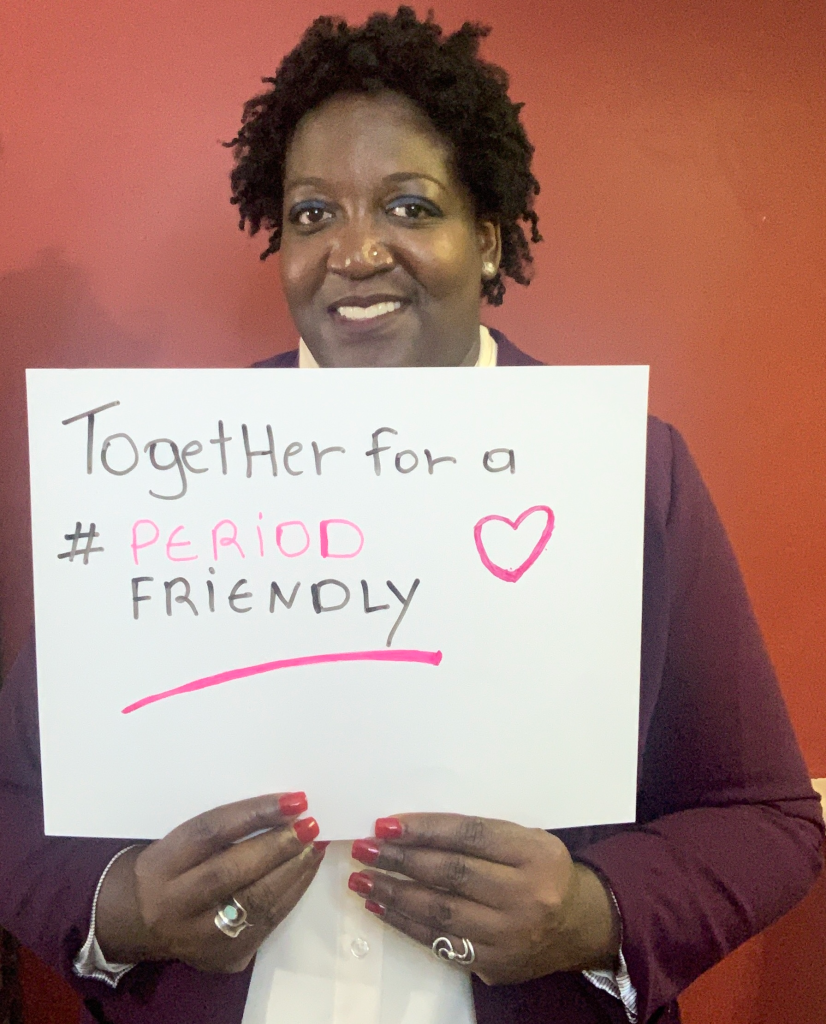
There is no doubt that the movement for menstrual equity has grown tremendously from its inception, but many grassroot organizations in Francophone Africa are still fighting to be Visibly Seated, Participant and Funded! All organizations, coalitions, and grassroots who are actors, advocates, or partners in the menstrual health movement should be given the same opportunities and/or resources and access not based on language, or geographic location, but simply because this is a global cause not for one, or a particular group, or country. On any given day, we are all in the ongoing battle for a more #PeriodFriendlyWorld!
Bienvenue Konsimbo
Founder Girl Now Woman Later
www.girlnowwomanlater.org